Not all air purifiers are created equal. The two things that matter most are the filter (a true HEPA filter captures 99.97% of particles down to 0.3 microns) and the clean air delivery rate, or CADR, which tells you how much air it can actually process for your room size. Everything below uses genuine HEPA filtration and avoids ozone-emitting "ionizer only" gimmicks.
We've ordered these from our top overall pick down through premium and budget options, so you can match one to your space and priorities. Prices shift constantly, so we link you straight to Amazon to check the current price rather than quoting numbers that go stale.
In this guide
- What to look for in an air purifier
- 1. AirDoctor AD3500 — best overall
- 2. IQAir HealthPro Plus — best premium
- 3. Coway Airmega 400 — best for large rooms
- 4. Levoit Core 600S — best value for big spaces
- 5. Blueair Blue Pure 211i Max — best quiet design
- 6. Coway Airmega Mighty — best budget
- Frequently asked questions
What to look for in an air purifier
- True HEPA filtration. Look for "True HEPA" or "HyperHEPA," not "HEPA-type." This is what captures fine particles, allergens, and smoke.
- A carbon filter for VOCs and odors. HEPA catches particles; activated carbon adsorbs gases, fumes, and smells. The best units have both.
- CADR matched to your room. Buy a unit rated for a space larger than your actual room so it can cycle the air several times an hour.
- No ozone. Avoid purifiers that rely on ionizers or "ozone generators," which can irritate airways. Every pick here is filter-based.
1. AirDoctor AD3500

Best overall
AirDoctor AD3500
Ultra-fine filtration for the whole room.
The AirDoctor is our top pick because its UltraHEPA filter is independently tested to capture particles far smaller than standard HEPA, plus a dual-action carbon/VOC filter for gases and odors. It's smart-app enabled, auto-adjusts to air quality, and quietly handles large living spaces — a genuine investment piece that earns its keep.
2. IQAir HealthPro Plus

Best premium
IQAir HealthPro Plus
The gold standard, used in hospitals.
If budget is no object and you want the most capable air purifier available, IQAir's HyperHEPA filtration captures ultrafine particles down to 0.003 microns — 100 times smaller than conventional HEPA. It's the unit clinics and allergy sufferers swear by. Built to last for years, it's a serious investment in the air you breathe every day.
3. Coway Airmega 400
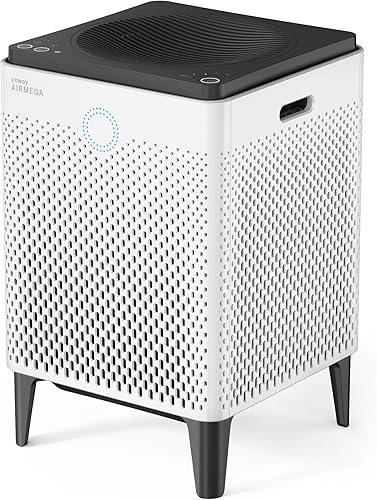
Best for large rooms
Coway Airmega 400
Powerful coverage, beautifully simple.
The Airmega 400 pairs a true HEPA filter with activated carbon and covers very large open-plan spaces with ease. A real-time air-quality light and smart auto mode mean it ramps up only when needed, and it's earned a devoted following for reliability. A brilliant balance of power, design, and value.
4. Levoit Core 600S

Best value for big spaces
Levoit Core 600S
Serious coverage without the splurge.
Levoit's Core 600S delivers large-room coverage and a genuine three-stage HEPA-and-carbon filter at a far friendlier price than the premium brands. It's smart-app enabled with air-quality sensing and a quiet sleep mode, making it the value pick that punches well above its weight.
5. Blueair Blue Pure 211i Max

Best quiet design
Blueair Blue Pure 211i Max
Whisper-quiet and lovely to look at.
Blueair's HEPASilent technology moves a lot of air while staying remarkably quiet, which makes the 211i Max a dream for bedrooms and nurseries. Swappable fabric pre-filters let you match it to your décor, and it covers large rooms with ease. Proof that effective can also be beautiful.
6. Coway Airmega Mighty (AP-1512HH)

Best budget
Coway Airmega Mighty (AP-1512HH)
The little unit everyone recommends.
Perennially one of the most-recommended purifiers anywhere, the compact Airmega Mighty offers true HEPA plus carbon filtration, an air-quality indicator, and eco auto mode for a fraction of the cost of the big units. Perfect for bedrooms, offices, and as a second (or third) purifier around the house.
Frequently asked questions
Where should I put an air purifier?
In the room where you spend the most time — usually the bedroom, since you're there for eight hours a night. Keep it a foot or two from walls and furniture so air can circulate freely, and run it continuously on a low setting rather than blasting it occasionally.
Do air purifiers help with VOCs and off-gassing?
Only if they include an activated carbon filter. HEPA alone captures particles, not gases. For new furniture, paint, or cleaning-product fumes, choose a unit with a substantial carbon stage — like the AirDoctor or IQAir.
Are ionizers or ozone purifiers safe?
We avoid them. Ozone-generating devices can irritate the lungs, and the EPA cautions against them. Every purifier in this guide is filter-based, and many let you turn any ionizer feature off.
How often do I replace the filters?
It varies by model and air quality, but plan on HEPA filters every 6–12 months and carbon pre-filters more often. Factor ongoing filter costs into your decision — the premium units cost more to maintain.
Why don't you show prices?
Air purifier prices change frequently with sales and bundles. Rather than quote a figure that may be outdated, we send you to the live listing — just tap "Check Price on Amazon."
The bottom line
Clean indoor air is one of the most underrated pieces of a healthy home. Start with your bedroom, choose a unit with true HEPA and carbon filtration sized for the space, and run it continuously. Any of the six above will make a noticeable difference — the AirDoctor for most, the IQAir if you want the absolute best.